Thales
Thales is the world leader in air mobility solutions. An impressive two out of every three aircraft around the world land and take-off with the help of Thales. Thales is trusted by key ATM decision makers across 180 countries, and helps key decision makers master complexity and make timely decisions for better outcomes.
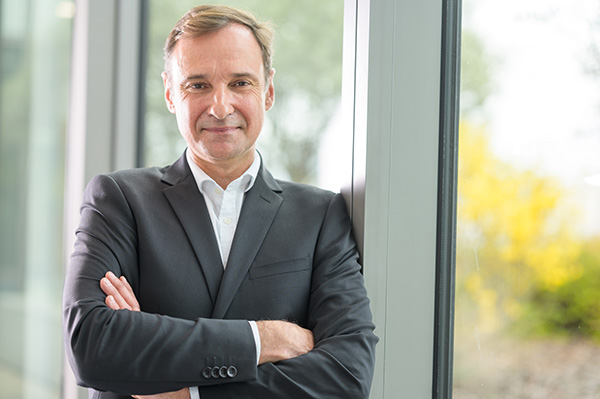
Youzec Kurp, Vice-President for Airspace Mobility Solutions, Thales
What is the added value of being a member of the SESAR Joint Undertaking?
Being a member of the SESAR Joint Undertaking provides Thales with the opportunity to take part to the definition of future Research and Innovation activities to be launched in Europe in coming years, and to ensure a proper alignment of technical/functional visions and investments. It is also a unique platform for public-private collaboration, where companies and ANSPs can work together to find solutions to common challenges in ATM.
Through active participation in SESAR JU and close collaboration with operational stakeholders, Thales ensures its solutions are aligned with European performance targets and ready for large-scale deployment.
Why is air traffic management and its digital transformation important to Thales?
The evolution of ATM technology has historically been very slow.
However, as new users begin to enter the airspace, traditional operational concepts face unprecedented challenges and the need for innovation has never been greater. In today’s data-driven world, as advanced technologies reshape how people and systems interact, the ATM industry is no exception.
Thales stands at the forefront of this revolution as a global leader and trusted expert in ATM, distinguished by its deep expertise in sovereign cloud solutions, cutting-edge artificial intelligence, and world-renowned cybersecurity capabilities.
At Thales, our strategy is fully aligned with the European ATM Master Plan, as we are committed to delivering a safer, more efficient, and sustainable airspace in line with the objectives of the Single European Sky. A key pillar of our contribution is our TopSky - ATC built on OpenSky Platform, which embodies the Master Plan’s vision of a service-oriented, modular, and interoperable ATM ecosystem.
By enabling an open architecture, Thales supports the seamless integration of diverse systems and actors, fostering scalable and flexible delivery of new ATM services, in the framework of the new service delivery model.
Thales’ commitment to innovation and advanced technology positions the company uniquely to accelerate the digital transformation and virtualisation goals outlined in the European ATM Master Plan. By delivering interoperable, resilient, and secure systems, Thales supports Air Navigation Service Providers (ANSPs) seamlessly digitalise and modernise their operations while fully safeguarding their sovereignty.
What are Thales’ top three innovation priorities?
The future transformation of ATM will be driven by several interconnected technological advancements, reflecting Thales’ commitments to a safer, greener and more inclusive world.
This technological evolution (Virtualisation, artificial intelligence (AI), cybersecurity and cloud technologies) aligns closely with Thales’ top innovation priorities:
- Advanced technologies: Delivering flexible, open, secure, and safe ATM and UTM platforms that integrate best-in-class third-party applications leveraging cloud architectures, cybersecurity and artificial intelligence.
- Sustainable aviation: Optimising flight paths and operations through advanced avionics and ATM systems contributes to a targeted 10% reduction in aviation CO2 emissions by 2030.
- Advanced airspace mobility: Ensuring safe, secure, and inclusive access to airspace by integrating traditional ATM with UTM for drones and preparing for future advanced airspace mobility solutions.
In which flagships of the Digital European Sky programme is Thales particularly interested in getting involved, and why?
The flagships of greatest interest to Thales are consistent with the innovation priorities stated above. First flagship of interest is “Aviation green deal”, in particular regarding trajectory optimization to reduce environmental impact (CO2and non-CO2), including generalised optimised climb & descent operations.
Second flagship is “Virtualisation and cyber-secure data sharing”, with the aim of supporting the operational deployment of a more flexible, open safe and secure ATM architecture, relying on the virtual centre and ATM data service provider concepts.
Third flagship is “U-space and urban air mobility”, with the aim of developing UTM, and ensuring effective integration with ATM.
Other flagships are also of high interest:
- “Connected and automated ATM”, with the aim of increasing the level of automation and interoperability supporting ATM operations
- “Air-ground integration and autonomy”, advancing further the development of trajectory-based operations, supported by downlinked aircraft data,
- “Artificial intelligence for aviation”, as a key enabler for a number of other flagship automation-relation programmes.