
ELSA, a recently-completed SESAR exploratory research project, has developed a series of tools to simulate and analyse the performance brought about by the gradual implementation of SESAR Solutions and the transition towards the SESAR Target Concept of trajectory-based operations.
The premise for the project, led by Deep Blue in cooperation with University of Palermo and Scuola Normale Superiore, was to develop modelling techniques to analyse the interaction between SESAR Solutions and to assess their performance impact in different implementation scenarios. The project consortium focused on three strands of activity:
- An extensive analysis of ATM data using Complex Systems theory techniques in order to characterise statistical regularities. Examples include variations in predictability during the flight execution phase, the correlation between traffic and safety metrics, and seasonal fluctuations;
- The development of an air traffic simulator to simulate and analyse current and future SESAR scenarios; and
- The design of a decision-support prototype to monitor complexity levels, predict likely outcomes and simulate the effects of changes to the system.
The ELSA Air Traffic Simulator
The main project outcome is a modular, open-source[1] ATM simulator based on interacting agents (mainly flights and controllers) and composed of the following modules (Figure 1):
- An airspace generator, including navpoints, sectors and a traffic generator used to test different traffic conditions;
- A trajectories generator, including a rectification module, used to straighten up trajectories when simulating free-routing;
- A Conflict resolution engine, including a tactical layer simulating a tunable, imperfect controller;
- A post-processing module, including standard metrics computation and a simple graphic interface to see isolated runs;
Together these models provided a tool with which to assess different future scenarios, in which for instance SESAR Solutions have been implemented but not fully deployed (Figure 2). The project’s proposed simulator could potentially measure using quantitative metrics the achieved optimisation, compare different solutions and carry out stress tests to see how various configurations cope with events, such as industrial action and adverse weather conditions.
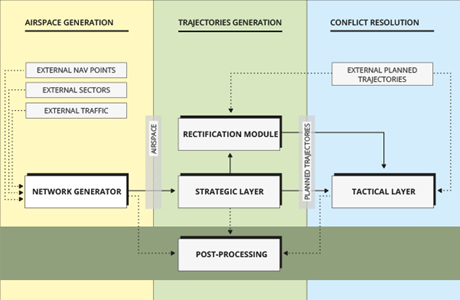
Schema of the ELSA Air Traffic Simulator (Credits: ELSA Project)
Next steps
The ELSA project has demonstrated the potential of applying Complex System techniques to ATM research but there is a lot more to be investigated. The techniques developed by the project could be used, for example, to extend the scope of the simulator to make it capable of investigating new concepts, such as the impact of information sharing on the airlines business choices, or the system’ resilience to major disruptive events.
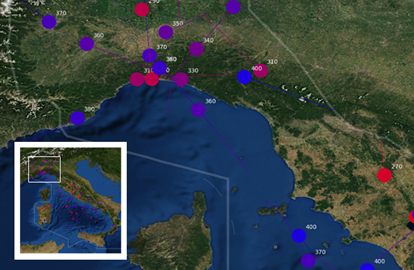
Example of the ELSA Air Traffic Simulator interface and capabilities (Credits: ELSA Project)
[1] The code has been released under the General Public License version 3, which means that it is open-source and freely downloadable. It is hosted on Github