
Guidance on getting the most out of the Catalogue
The online SESAR Solutions Catalogue contains the technological and procedural solutions needed for delivering the Digital European Sky. Browse this quick guide to find out how to get the most out of this online resource!
Solutions in numbers
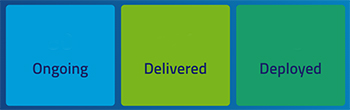
Delivered Solutions in this section include those deployed. It should be noted that the number of solutions “deployed” fluctuates (upwards/downwards) subject to the status reported by states and their definition of deployment/understanding of the SESAR Solution.
Filtering solutions
The solutions can be filtered according to the following:
SESAR 3 JU reference
This refers to the solution identify number and reference within the framework of the research and innovation programme, e.g. # PJ.25.01 /RELEASE 10
Key operational areas
SESAR Solutions meet specific operational needs. For each solution, the targeted operational areas are indicated using these icons.
 |
High-performing airport operations, including total airport management, remote towers, runway throughput capabilities, navigation and routing tools, airport safety alerts for controller and pilots |
 |
Advanced air traffic services, including time-based separation and European wake vortex re-categorisation (RECAT-EU), better sequencing of traffic, automation support tools, integration of all vehicles |
 |
Optimised network operations, including dynamic collaborative tools to manage ATC airspace configuration (sectors), and civil-military collaboration for greater predictability and management of operations and airspace use |
 |
Enabling infrastructure, including CNS integration to facilitate economies of scale and seamless service delivery; and system-wide information management governance, architecture and technology solutions and services for information exchange |
Stakeholders
SESAR Solutions meet the business needs of a range of ATM stakeholders. For each solution, the targeted stakeholders.
| ANSP | Airspace navigation service providers (civil and military) |
| AO | Airport operators |
| AU | Airspace users |
| NM | Network Manager |
Benefits
 |
Increased cost efficiency | Refers to the costs associated with air navigation service provision |
 |
Enhanced safety |
Covers gate-to-gate traffic safety (in flight as well as during surface movement, i.e. taxi and on the runway).
|
 |
Improved predictability |
Measured by the variability in the duration of the flight. |
 |
Optimised capacity | Covers capacity at airports, terminal manoeuvring areas and en-route airspace. |
 |
Reduced fuel consumption and emissions |
refers to the average reduction in fuel consumption per flight in Europe (at the level of European Civil Aviation Conference). |
Status
| Ongoing | Refers to solutions still undergoing research and innovation |
| Delivered | Refers to solutions that are available for industrialisation |
| Deployed | Refers to solutions that are either part of Europe-wide synchronised deployment or implemented locally*. |
Maturity level
Through its innovation pipeline, concepts are transformed into solutions ready for industrialisation.
| V1/TRL2 | Technology concept formulated |
| V2/TRL4 | Technology validated in a ‘laboratory environment’ |
| V3/TRL6 | Technology validated in operational environments with industrial prototype(s) |
Strategic Deployment Objectives
SDOs are prioritised actions that need to be rolled out between 2025 and 2035. These actions are critical for achieving the vision and performance ambitions and are based on SESAR Solutions either already delivered or in the pipeline. These 10 SDOs provide the basis to trigger accelerated market uptake of SESAR Solutions by a critical mass of early movers and to support the updating of the regulatory framework.
SDO 1 - Alerts for reduction of collision risks on taxiways and runways
SDO 2 - Optimising airport and TMA environmental footprint
SDO 3 - Dynamic airspace configuration
SDO 4 - Increased automation support
SDO 5 - Transformation to trajectory-based operations (TBO)
SDO 6 - Virtualisation of operations
SDO 7 - Transition towards high performance of air-ground connectivity (multilink)
SDO 8 - Service-oriented delivery model (data-driven and cloud-based)
SDO 9 - CNS optimisation, modernisation and resilience
SDO 10 - Enable innovative air mobility (IAM) and drone operations
Implementation locations
See section 'Map View below
Linked projects
Refers to the industrial projects in which the solutions were developed and validated.
Linked solutions
Refers to solutions with similar characteristics but addressing potentially different operational environments or operational aspects.
Datapack
When a SESAR Solution has reach the required level of maturity for industrialisation (TRL6/V3), a datapack is published containing the following set of documents:
- Contextual note (CN): Summarises the scope of the SESAR Solution and main operational and performance benefits, relevant system impacts, etc. When a SESAR Solution is at TRL6 level, the contextual note makes recommendations regarding additional activities to be conducted during the industrialisation phase or as part of deployment. It cross-references the technical data pack comprising the SESAR JU deliverables.
- Safety and performance requirements/Interoperability requirements /Operational service and environment description (SPR-INTEROP/OSED): Contains the safety and performance requirements and interoperability requirements related to a SESAR Solution, while also describing the applicable environment, assumptions, etc. The requirements are backed up with an appendix detailing transversal assessments and a performance assessment report.
- Technical specifications/interface requirements (TS/IRS): Provides the functional, non-functional and interface requirements related to a SESAR Solution. The technical specifications address the “what” and not the “how”, they aim at specifying the functional description and the necessary logical interfaces between the SESAR Solution and other parts of the ATM system.
- Cost-benefit analysis (CBA): Documents the potential benefits, when deployed in the applicable environment(s), of a SESAR ATM Solution or a SESAR Technological Solution (CBAT), and whether or not they are expected to exceed the costs over a given time horizon.
The datapack may be completed with a demonstration report (DEMOR), where relevant, which consolidates the results obtained from demonstration exercises. These reports may result in an update of the abovementioned requirements and assessment documents.
Map view
The map displays where SESAR solutions are being deployed across Europe*.
Yellow circle denotes >10 deployments
Green circle denotes < 10 deployments
Zoom in to view the following:
 |
Deployments at specific airports |
 |
Nationwide deployments |
 |
Deployments in specific airspace |
Want to put your implementation on the map?
Let us know, contact communications@sesarju.eu
* DISCLAIMER: The deployment data displayed in the map and dashboard are based on the EUROCONTROL Local Single Sky ImPlementation (LSSIP+) process, which monitors implementation via ESSIP Implementation Objectives defined by the EUROCONTROL Implementation Plan and Report. It should be noted that the number of solutions “deployed” may fluctuate (upwards or downwards) depending on the status reported by states and their definition of deployment/understanding of the SESAR Solution. In some instances, there may also be differences between the ESSIP Implementation Objective and the technical enablers of its associated SESAR Solution(s), meaning that the full scope of the SESAR Solution may not be covered.