
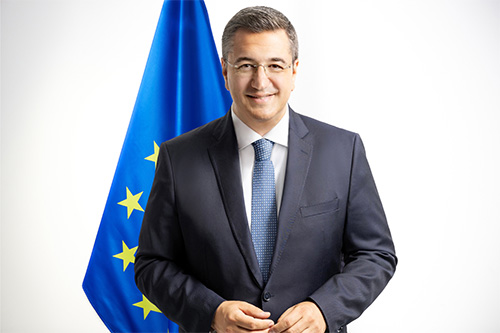
Perspective by Apostolos Tzitzikostas, European Commissioner for Sustainable Transport and Tourism
As we reflect on our achievements and look to the future of European aviation, one thing is clear: innovation is everywhere. It has been, and will always be, the driving force behind our successes. In this respect, the SESAR Joint Undertaking is synonymous with innovation. This unique partnership between the European Union and the aviation industry has enabled Europe to build cooperation at scale and deliver solutions with tangible, real-life impact.
As European Commissioner for Sustainable Transport and Tourism, I have had the privilege of witnessing firsthand the remarkable progress being made across the sector. Over the past year, the SESAR Joint Undertaking has played a pivotal role in developing and deploying cutting-edge technologies that are transforming Europe’s air traffic management (ATM) system, making it more efficient, more resilient and more sustainable. I am particularly proud that SESAR has succeeded in making ATM truly European, bringing together the best minds and expertise from across the continent around a shared goal of modernisation.
The impacts of SESAR are both measurable and impressive. For every euro invested, we see returns of €6.70, translating into €24.2 billion in industry benefits by 2035. These figures speak volumes about the value of collaboration and the strategic importance of sustained investment in research and innovation.
.jpg)
But SESAR is not just about numbers. It is also, above all, about people. SESAR solutions have already saved passengers 260 million minutes of travel time, reduced CO₂ emissions by 13.6 million tonnes and cut fuel consumption by 4.3 million tonnes. These are concrete benefits for European citizens and for our environment. Indeed, SESAR solutions are putting European aviation firmly on track to achieve its net-zero objective by 2050.
A faster implementation of SES2+, making full use of modern digital technologies, must therefore be our first step. This will allow the sector to unlock further efficiency gains and improve performance across the network. It is also a matter of competitiveness and strategic autonomy: around 70% of global ATM technologies are managed by European companies. Deploying these technologies more widely not only delivers a more efficient aviation system, but also strengthens Europe’s industrial leadership.
These are compelling reasons to support the Aviation Research and Innovation Strategy (ARIS), unveiled this
summer, which calls for €66 billion in investment between 2028 and 2034. It sets out a clear roadmap for Europe to remain at the forefront of aviation innovation.
Looking ahead, I also look forward to receiving an ambitious proposal for a Common Project Two next year. This initiative should include innovative ATM technologies deployed in a coordinated and synchronised manner across Europe. Such an approach will be essential to building more agile, dynamic and interconnected systems, fully embracing new developments in artificial intelligence and cloud-based computing.
Partnerships will remain central to achieving these objectives. The European Commission’s proposal for the next multiannual financial framework, currently under negotiation by the co-legislators, includes a “smart and clean aviation moonshot” as a flagship measure. This initiative aims to support the development of the next generation of CO₂-free aircraft and automated air traffic management systems. Delivering on this ambition will require close cooperation between the Union, industry and the research community — and I am fully committed to working with all partners to turn this vision into reality.
Going forward, synergies and collaborative approaches must be at the heart of our work. This is how we will unlock the full potential of cross-border ATM solutions and dual-use technologies. A strong example is the Commission’s Military Mobility package, adopted in November, which sets out ambitious air mobility objectives — from a cross-border framework to facilitate military operations to the creation of a network of dual-use airports.
As we move into 2026, I encourage the SESAR research and innovation community to continue pushing the boundaries of what is possible. We are entering the final years of implementation of the current SESAR 3 Joint Undertaking, while at the same time negotiating the next multiannual financial framework. Europe needs a clear, ambitious plan for ATM modernisation — and we must be bold in shaping it.
I look forward to continuing our close partnership and working together to secure Europe’s position as a global leader in aviation. By embracing innovation, we can build a sustainable and competitive aviation sector that delivers real benefits for all Europeans.
Get more perspectives in the DigitalSky: SESAR research and innovation digest