
Putting a hold on holding patterns
Extended arrival management (AMAN)

Faced with increasing traffic, air navigation service providers (ANSPs) are looking for new ways to overcome congestion and reduce the need for holding.
Extended arrival management ticks both boxes.
Aviation is facing an imbalance in supply and demand. While the IATA airport slot system, together with flow management (when available), ensures that demand does not exceed capacity within the strategic planning horizon, operational delays can cause demand for runway and terminal airspace to temporarily exceed capacity.
When this happens, controllers often implement a holding pattern where flights are kept waiting until the airspace or runway ahead of them becomes available – a decision that results in increased fuel burn and thus more emissions.
Helping mitigate this need to hold is arrival manager (AMAN), a tool that air traffic controllers can use to efficiently manage inbound traffic and make the best use of available runway and airspace capacities.
AMAN, however, only allows air traffic controllers to meter traffic into a terminal manoeuvring (control) area (TMA). But if the AMAN horizon was extended beyond the TMA, en-route controllers (workload permitting) could instruct pilots to adjust their speed before top-of-descent, thus further reducing inefficient flight profiles and holdings.
THE INNOVATION

By extending the AMAN horizon further upstream, extended-AMAN (E-AMAN) (Release 4 SESAR Solution #05) allows the sequencing of arrival traffic much earlier than what is possible with the basic, purely TMA-configured AMAN.
E-AMAN is supported by sharing the airport’s arrival management information with upstream sectors in real time. All parties share the same information using a system-wide information management (SWIM) service.
ATC in the upstream sectors, which may be in a different control centre or even a different functional airspace block, are provided with arrival management advisories to support an earlier pre-sequencing of aircraft.
Controllers implement these advisories by, for example, instructing pilots to adjust the aircraft speed along the descent and/or before top-of-descent. Because the aircrew knows about a delay well in advance, they have more options for absorbing it.
THE IMPLEMENTATION
.png)
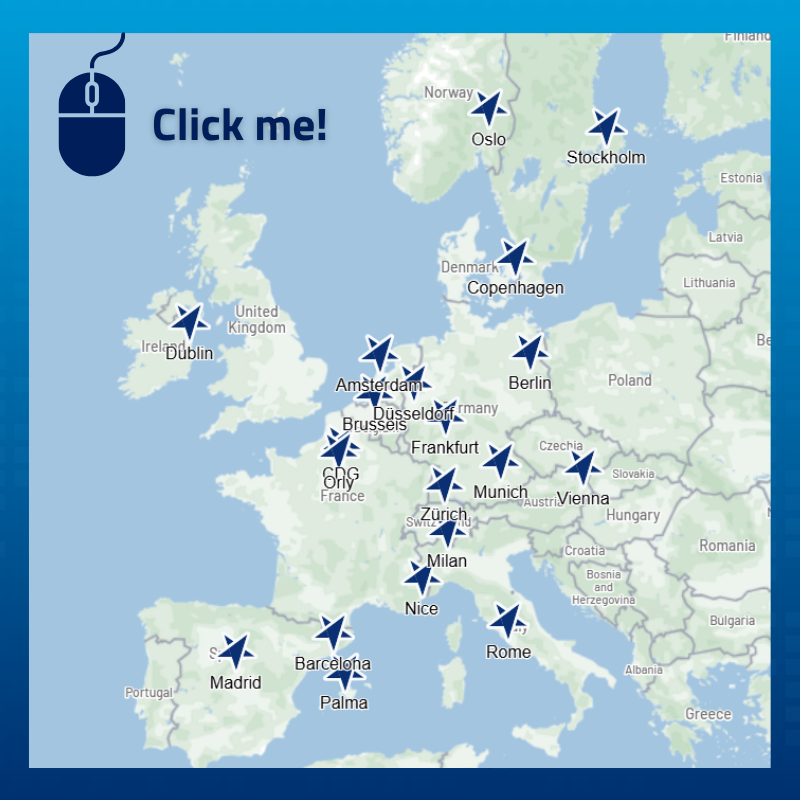
The Common Project One Regulation (CP1) requires E-AMAN to be implemented within 180 nautical miles (about 333 km or 45 minutes of flight time) of the EU’s 20 busiest airports. The SESAR Deployment Manager has supported this implementation at such airports as Paris Charles de Gaulle (CDG) and Orly.
Attracted by its ability to reduce congestion in the TMA, as well as ATC workloads and fuel burn, Paris ACC (the French ANSP) began conducting numerous trials with E-AMAN in 2018 and within the framework of the SESAR xStream project.
One of the key outcomes of these trials was confirmation that E-AMAN allows ATC to reduce flight speeds in the upper airspace well before they arrive in the TMA (200 – 300 nautical miles out). This means there is less need to implement holding patterns or radar vectoring in the lower airspace. According to Paris ACC, even a minor reduction in speed equates to as much as half a holding pattern[1] at low altitude.
Paris ACC also demonstrated how E-AMAN enables more advanced planning. For example, if the EUROCONTROL Maastricht Upper Area Control Centre (MUAC) sees that CDG sends requests for a slowdown every Tuesday morning, it could proactively plan for those requests by organising its sectorisation accordingly.
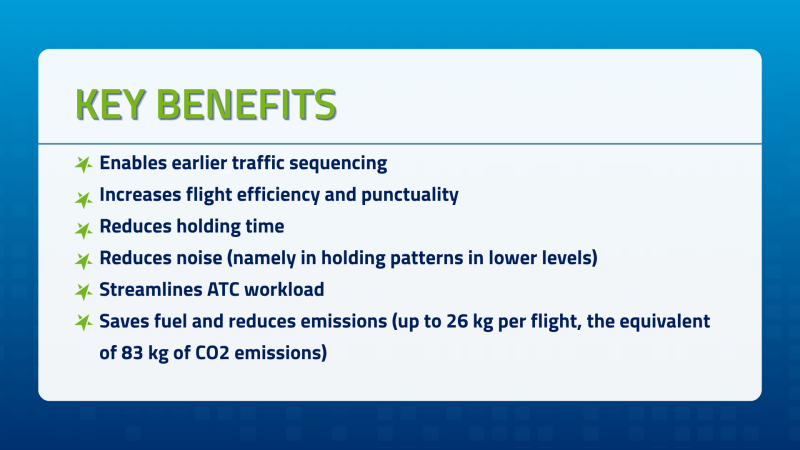
Since its full implementation in 2020, Paris ACC has reduced the use of holding patterns within the TMA, especially during periods of low capacity (e.g., low visibility procedures, runway works or convective phenomena). This in turn has led to a 5% average reduction in fuel consumption and CO2 emissions in the TMA for an entire arrival flow.
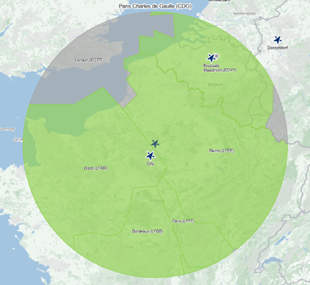
Showing the 180 NM horizon around Paris CDG. Grey zones are exempt from the implementation requirement as per Regulation text.
IMPLEMENTATION STATUS
[1] A regular holding pattern takes about 4 minutes to complete at altitudes below FL140.