Delivering air traffic services remotely
Single digital remote towers
Not every airport can afford to operate a control tower around the clock. SESAR’s remote tower concept offers the means to provide cost-efficient air traffic services to low-traffic airports, as well as to some medium-density ones.
For many low-volume airports, conventional control towers are too expensive to operate and maintain. Even at medium-volume airports they can become too costly if the number of flights is insufficient to cover the running costs.
The result can be an underutilisation of available resources – resources that not only could be used elsewhere but are also very costly to be left sitting idle. For example, an air traffic controller working at a very quiet airport that receives only a few flights per day is an underutilised resource. The reverse situation is also common, where very high demand for ATC occurs at major airports during peak times, resulting in an insufficient availability of controllers.
Helping ensure a more balanced and efficient use of ATC resources is the remote tower concept.
With remote tower technology, the air traffic control officer is no longer situated inside a conventional tower facility at the aerodrome. Instead, they perform air traffic services (ATS) for the concerned aerodrome remotely, providing services that may not be available onsite around the clock.
THE INNOVATION
The SESAR has been at the forefront of remote tower technology. For example, with 'Single remote tower', SESAR partners demonstrated the feasibility of providing air traffic services from a remote tower.
While the remote tower concept has typically been associated with low-traffic density airports, SESAR decided to look at whether the single remote tower set-up could be used at airports with medium-sized traffic volumes as well. Finding that this category of airports faces similar challenges as their smaller counterparts, it developed SESAR Solution 12 / Release 5. The solution essentially validates the use of remote towers at medium size aerodromes that frequently have more than one movement simultaneously.
SESAR partners also demonstrated how a remote tower facility can provide contingency services at airports with medium-sized traffic volumes (SESAR Solution 13 / Release 5). Contingency remote towers provide remote air traffic services to an aerodrome when the local tower is not available and the services need to be provided from a back-up location.
THE IMPLEMENTATION
The remote tower concept was first implemented by Luftfartsverket (LFV), Sweden’s state-owned ANSP, together with Saab, a provider of digital air traffic solutions.
While rural airports like Kiruna, Örnsköldsvik, Sundsvall and Östersund all play a vital role in keeping surrounding communities connected to the rest of the country, the cost of operating them often outweighs demand. Moving these airports’ ATS units to a remote tower centre (RTC) was an opportunity to increase staff efficiency and reduce overhead costs.
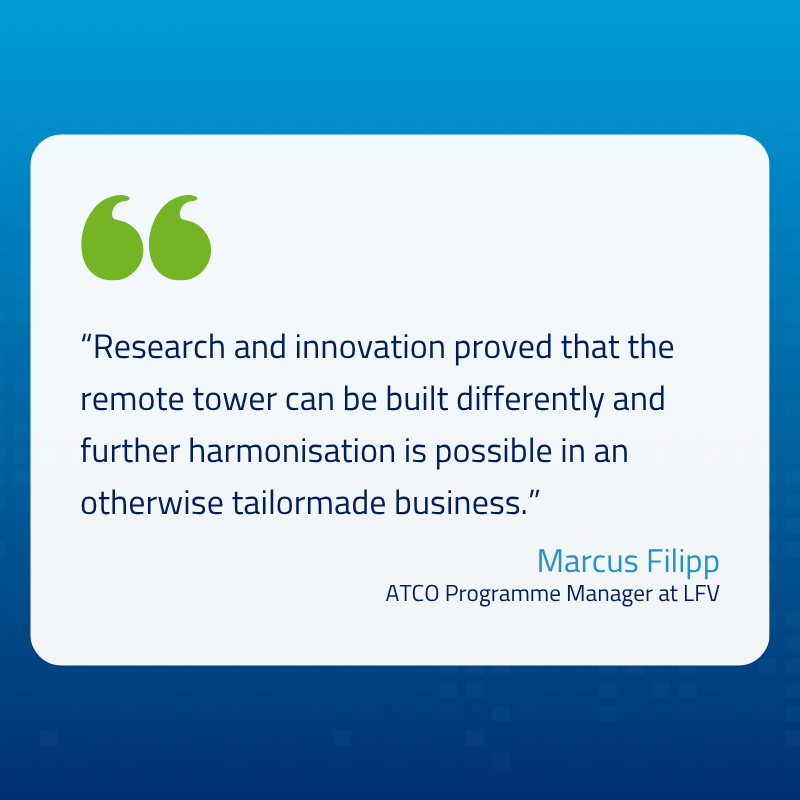
LFV and Saab began performing conceptual experiments as early as 2006 and, in 2010, they decided to start a full-scale project. But being the first to implement the remote tower concept meant the partners had to do so without the benefit of any guidance or set standards to follow. This made it particularly challenging to convince airlines, airport operators, ATC, regulators and even the public that it was in fact possible to conduct air traffic services remotely without impacting safety or regularity.
To make their case, LFV and Saab, conducted comprehensive safety assessments covering nearly every conceivable risk, from technological issues like problems with the radar data or visual presentation units to how controllers utilise digital tools.
Following this extensive validation process, the first RTC went live at Sundsvall Airport in 2014. This was followed by a second RTC located at Stockholm Airport in 2019.
The RTCs serve as a centralised operations room, with each centre hosting several remote tower modules. These modules are then connected to a single airport. For example, both the Sundsvall and Stockholm RTCs have four remote tower modules, meaning each centre operates four different airports using approximately 40 – 50 air traffic controllers.
In the current setup, each ATC station is equipped with large displays on floor stands that provide controllers with a complete picture of the airport from a single vantage point. However, Saab is working to further streamline the RTC setup, with the trend being towards an open workspace layout and introducing smaller displays that can be placed on a controller’s desk in a way that doesn’t compromise their ability to monitor objects of interest.
LFV and Saab are now using their more than a decade of experience to help ANSPs implement remote tower centres across Europe. This includes London City which, in 2021, became the first international airport to be fully controlled by a remote digital air traffic control tower.