The multiplier effect of SESAR remote towers
Multiple remote towers
Having proved the safety and efficiency of remote tower technology, SESAR partners turn to investigating the feasibility of allowing controllers to manage more than one airport at a time – work that ultimately leads to the development of the multiple remote tower concept.
While remote tower technology already represents a step change in the provision of air traffic services—improving cost-effectiveness and resource allocation—it also opens the door to unlocking even greater efficiency gains.
This is where multiple remote towers come in.
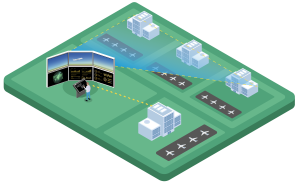
Whereas a remote tower allows air traffic control (ATC) to manage one, often low-traffic airport from a remote, screen-based facility, the multiple remote tower concept allows one controller to manage two or more airports simultaneously or sequentially, exponentially increasing cost efficiency and maximising resources.
To achieve this, multiple remote towers build on the remote tower concept, the main difference being that the camera feed from the airport is relayed not to a single remote tower but to a remote tower centre (RTC), where a pool of air traffic controllers can balance demand among themselves as needed.
THE INNOVATION
.png)
Having proved that controllers can provide air traffic control services to an airport remotely, the SESAR partners validated the feasibility of providing simultaneous services to two airports from a single location (i.e., ‘the multiple remote tower’).
The solution ‘remote tower for low-density aerodromes’ (SEAR Solution 52 / Release 4) offers new possibilities for low volume airports where building, maintaining and staffing a conventional tower is unaffordable. It promises more efficient and cost-effective deployment of operational resources while also improving service continuity and maintaining safety.
Building on this solution is the multiple remote tower module (MRTM) (SESAR Solution PJ.05-02 / Release 9). The MRTM allows controllers to combine aerodromes – including those of different sizes – during periods of low traffic or to split them when things get busy.
SESAR figures indicate that the MRTM can simultaneously handle two airports with 15 000 to 40 000 annual movements or three airports with less than 15 000 annual movements. It has also been shown that MTRM can handle the same traffic volume as the single remote tower with up to 25 % fewer controllers.
Linked to MRTM is the remote tower centre (RTC) (Solution PJ.05-W2-35 / Release 13), a solution that brings together a number of modules to cover several different airports from one place. At an RTC, an air traffic controller provides air traffic services to up to three low traffic volume airports at the same time. Thanks to the pooling of resources, controllers can also assist each other when the traffic at one airport becomes too complex to handle alone.
THE IMPLEMENTATION
.png)
The multiple remote tower concept is being implemented at airports across Europe – including in Norway. Here, Avinor, the Norwegian air navigation service provider (ANSP), started multiple airport operation trials at their Bodø RTC in February 2026.
The RTC has 16 working positions from which an aerodrome flight information service officer can operate up to three airports simultaneously. A supervisor oversees the planning and allocates airports to the different working positions, ensuring seamless and efficient operations.
The centre uses Indra’s InNOVA air traffic management system, which provides a unique single and fully integrated display with all required air traffic and airport control functions. This includes the air traffic situation display, electronic flight strips and meteorological information. The visual system is provided by Kongsberg Defence & Aerospace.
Before launching the trial, Avinor conducted extensive system upgrades, implemented and adjusted procedures, and trained operational personnel at the RTC.
Once the trial began, Indra conducted various simulations designed to identify potential ‘pain points’. One thing they considered was a situation where an aerodrome flight information service (AFIS) officer operates two to three low traffic airports with low traffic when traffic at one of these airports suddenly picks up. In this situation, it was determined that AFIS officers need to be able to ‘handoff’ control of the airports to another operator.
Indra also found that ATC workload is not only impacted by the number of aircraft movements, but also by the type of aircraft and an airport’s setup. For instance, a movement involving a light aircraft must be monitored more closely than that of IFR scheduled traffic. Furthermore, when an airport layout lacks a parallel taxiway, an operator must spend more time monitoring the aircraft taxiing on the runway.
After trying different concepts and mock-ups, Avinor and Indra settled on a solution that allows controllers to dynamically allocate an airport to another controller when the workload at one of their airports increases. Clear criteria and procedures were also established for when multiple operations can be activated and deactivated. The process is based on the initial operational validation conducted by Indra and Avinor as part of the PJ05 SESAR Remote Tower project.
Based on the success of these tests, Avinor officially launched trial operations of its multiple remote tower concept at four select airport pairs, becoming the first in the world to implement multiple airport operations for digital towers. As of today, an AFIS officer working in the Bodø RTC can manage multiple airports from a single workstation.
The RTC currently operates 14 airports (planned to be extended to 22) located across the country, with the most remote being nearly 1 000 kilometres away. The airports connected to the RTC are mostly small- and medium-sized, with movements ranging anywhere from 5 000 to 10 000 per year.