A wise pairing of technologies
Time-based and pairwise separation
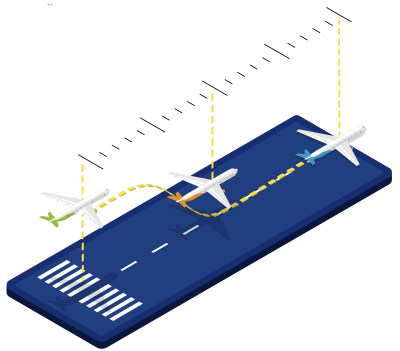
While time-based separation (TBS) sets minimum time gaps between aircraft based on wind, pairwise tailors these separations for specific aircraft pairs. But put them together, and what you get is a powerful tool for increasing capacity and reducing delays.
As an aircraft flies, it leaves a wake vortex – a type of rotating turbulence from the aircraft wing that can be quite dangerous for any aircraft travelling too close behind.
To mitigate this risk, ICAO has long set specific ‘separation rules’ for keeping aircraft a safe distance apart. These rules categorise aircraft as either super heavy, heavy, medium or light, with spacing determined by which category of aircraft leads and which follows.
However, because this spacing is fixed and based only on an aircraft’s general size, they don’t always facilitate the most efficient operations. This is particularly true during approaches, a phase that sees aircraft flying a pre-determined airspeed to maintain the minimum separation distances. But an approach is also when an aircraft is likely to be flying into a headwind, which causes them to fly more slowly over the ground.
The net result is that for a set separation distance there is a bigger time gap between each arriving flight.
Because ATC must maintain set separation distances between arriving aircraft, when the time gap grows, an airport’s landing rate is reduced. At airports where moderate or high winds are a regular occurrence, such as London Heathrow, this reduction can have a significant impact on operational performance, causing delays, increased holding patterns and CO2 emissions. It can even impact passenger satisfaction.
THE INNOVATION
SESAR partners including EUROCONTROL and NATS, the UK air navigation service provider (ANSP), conducted extensive research on whether this gap could be reduced during windy arrivals. More specifically, they wanted to know whether aircraft spacing could be dynamically calculated on arrival, a change that would allow ATC to maintain (or even increase) the landing rate while also reducing the risk of disruption.
What they discovered was that the wake vortices created by an aircraft dissipate more quickly during strong winds, meaning that the stronger the headwind, the closer together the aircraft can safely fly.
This finding laid the foundation for what would become time-based separation (TBS) (SESAR Solution No. 64).
TBS calculates the optimum time interval between arrivals based on live weather data and aircraft type (organised into six weight-based categories). The resulting time-based interval then appears as an indicator on a controller’s radar screen, with ATC’s role being to line up each arrival as close to that line as possible.
While TBS factors in wind speed, it does not consider the variation in wake vortex created by individual aircraft types and how a specific aircraft might cope with that wake.
Seeing an opportunity to achieve even further increases in operational efficiency, SESAR JU, EUROCONTROL and NATS identified specific values for each aircraft type and, based on this, the separation requirements for each pair of aircraft types. What air traffic controllers needed was the ability to determine the minimum safe separation for each specific pair of aircraft, rather than relying on broad wake turbulence categories.
This work laid the foundations for the ‘pairwise separation’ HYPERLINK "https://www.sesarju.eu/sesar-solutions/wake-turbulence-separations-arrivals-based-static-aircraft-characteristics"(#PJ.02-01-04 /Release 9), which defines how separation minima can be refined based on the performance characteristics of individual aircraft types.
Pairwise provides controllers with indicators showing exactly what the specific separation is between any two aircraft on final approach. With this information, they can vector aircraft onto the runway centreline behind the given indicator, allowing them to further tighten up those separations that can be reduced.
While TBS sets minimum time gaps between aircraft based on wind, Pairwise builds on this by tailoring these separations for specific aircraft pairs, moving beyond static weight categories for even greater capacity and efficiency. Think of TBS as dynamic time spacing and Pairwise as hyper-personalised spacing using aircraft-specific data, with the latter providing the specific separation rules for aircraft pairs and TBS applying the dynamic, wind-adjusted distance needed for efficient spacing.
TBS and Pairwise aren’t just compatible, they’re designed to be used together through specialised ATC support tools. For example, tools like Eurocontrol's optimised runway delivery and NATS' Intelligent Approach tools enhance runway capacity by dynamically calculating reduced separation minima based on specific aircraft types (Pairwise) and real-time wind conditions (TBS).
THE IMPLEMENTATION
NATS implemented TBS (via its Intelligent Approach tool) at London Heathrow in 2015 (project No. 097AF2).
Since then, headwind-related delays have been reduced by 60 %. The implementation of TBS also increased controller efficiency, essentially delivering an average of two extra landing slots per hour. On a strong headwind day, that number can be as much as four landing slots per hour.
Although London Heathrow has capacity limits, these additional slots reduce airborne holding as they allow ATC to get circling aircraft on the ground faster. Over the course of a year, TBS can save nearly 230 000 minutes of holding, which equates to 15 000 tonnes of fuel and 47 000 tonnes of CO2 emissions. This reduction in holding, and the decrease in delays that follows, has further contributed to a 4.5 % increase in customer satisfaction at the airport.
In collaboration with NATS, Amsterdam Schiphol Airport implemented TBS via the tool Intelligent Approach, which has since seen its capacity for landing aircraft during high wind conditions increase by three to six additional aircraft per hour, per runway.
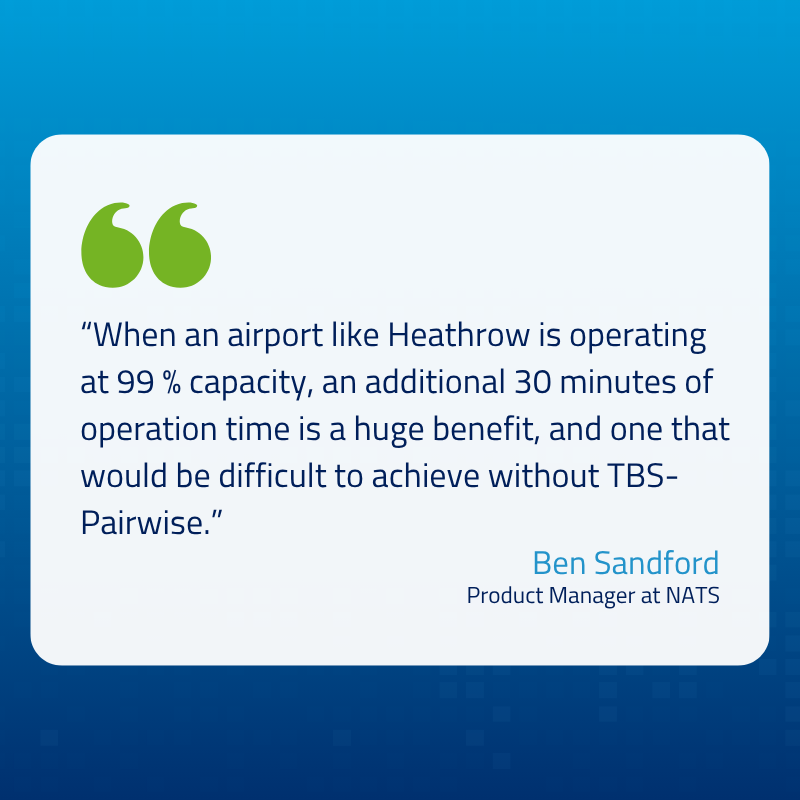
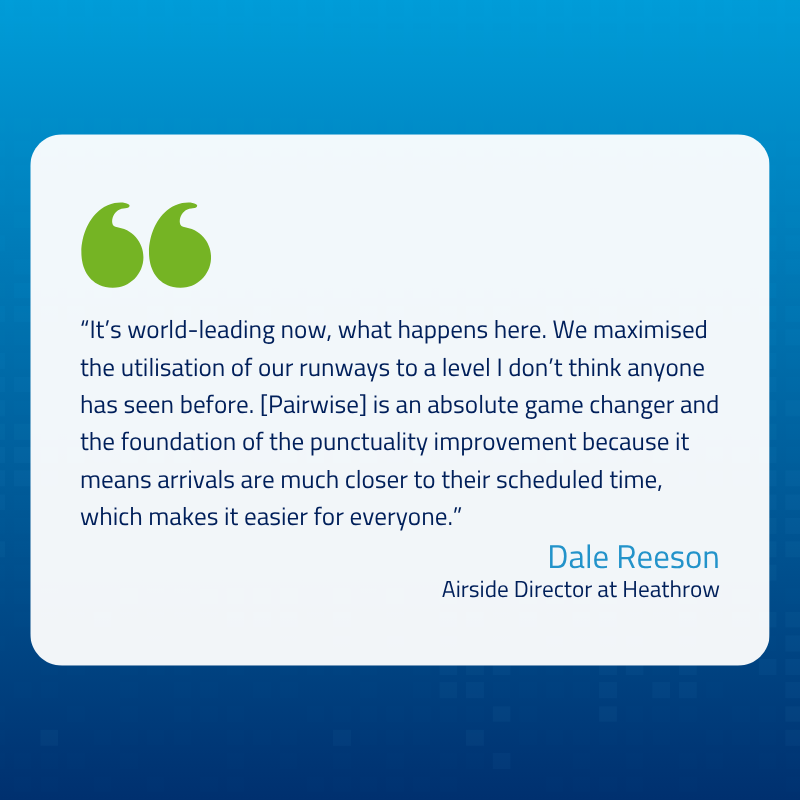
In December 2024, NATS added Pairwise to its Heathrow approach operation – a move that has delivered an additional 1.5 movements per hour on top of what was already achieved via TBS. Airborne holding also decreased, with the airport seeing a nearly 20 % improvement in average delay per arrival since Pairwise was introduced on top of TBS.