Transforming flight planning for more predictable operations
Flight and Flow – Information for a collaborative environment (FF-ICE)

The SESAR Joint Undertaking (SJU) and Deployment Manager (SDM) contributed to the development and implementation of the new FF-ICE flight plan, exchanged through Eurocontrol Network Manager FF-ICE services with airlines, and air navigation service providers (ANSPs) .
The Flight and Flow Information for a Collaborative Environment (FF-ICE) concept is intended to address the limitations and constraints of the current flight planning mechanism. In doing so, it enables the transition to a fully collaborative environment where a flight trajectory is shared and optimised during all phases of a flight (i.e. within a trajectory-based operations (TBO) environment).
THE INNOVATION
FF-ICE operates within a system-wide information management (SWIM) environment in which the main procedures and processes are described in terms of services. In Europe, those services are being implemented, with the first phase introducing services for the pre-departure phase of flight. Each service is supported by harmonised procedures and standardised messages that enable stakeholders to plan, file, update or cancel flights plans, provide data on certain flight events and request and receive flight plan information and data. Whereas in the ICAO 2012 format, the complete pre-departure image of a flight was a puzzle composed of a series of messages, the FF-ICE flight plan offers a complete image of that planned flight – with much richer data content including flight specific performance data, aircraft take-off mass, four-dimensional trajectories and globally unique flight identifiers – using the Flight Information Exchange Model (FIXM) performance data.
The SESAR Joint Undertaking contributed to the development of FF-ICE. Proofing the concept, SESAR Solution “Flight plan (extended Flight Plan) distribution to ATC“ expanded the flight plan data information exchange, showing improvements in the pre-flight phase alignment of trajectories between Network Manager, ATC and airspace users. This enhances trajectory prediction for both ATC and the Network Manager, particularly in complex airspace, supporting more effective flow management and ensuring a shared operational view between controllers and flight crews.
THE IMPLEMENTATION
EUROCONTROL Network Manager (NM) is the first and only FF-ICE services unit in the world and has provided FF-ICE services for the EUROCONTROL-managed European airspace where flight plans are centrally processed, since 2022.
The Network Manager together with the SESAR Deployment Manager (SDM), manages and coordinates FF‑ICE deployment through an FF-ICE joint initiative that actively drives the implementation of the FF-ICE flight plan, enabling stakeholders air navigation service providers and airspace users to transition away from the legacy format (i.e. ICAO FPL2012).
One of the outcomes of this joint initiative was Lufthansa becoming the first airline to submit an FF-ICE flight plan to the NM for an operational flight in 2022 (Project 2016_008_AF4). Other Airlines have since started to file FF-ICE flight plans, for example Air France who finalised their implementation in December 2025. The more airlines that file FF-ICE flight plans, the better the overall network benefit to them is.
But airlines are just one side of the equation. To leverage FF-ICE’s full potential, it must also be implemented by air navigation service providers (ANSP). Only then, the additional information in the flight plan can create additional value to operations.
With the SDM’s support, and within a multistakeholder deployment project “FF-ICE R1 – eFPL” (2022_035_AF5 FF-ICE R1 eFPL), in 2025, Romania’s ROMATSA became the first ANSP to process FF-ICE flight plans.
ROMATSA's FF-ICE implementation marks a pioneering, unique result globally, as the first ANSP to transition to live operations, fully compliant with CP1 requirements. This less than 2 years challenging journey was possible through the joint effort of all the actors involved in the process, alongside ROMATSA, including their ATC system provider, the Romanian CAA, SDM, and NM. ROMATSA notes that their successful FF-ICE implementation over SWIM benefited from coordination received from the SDM, and the co-funding and support of the European Commission through the Connecting Europe Facility (CEF) programme.
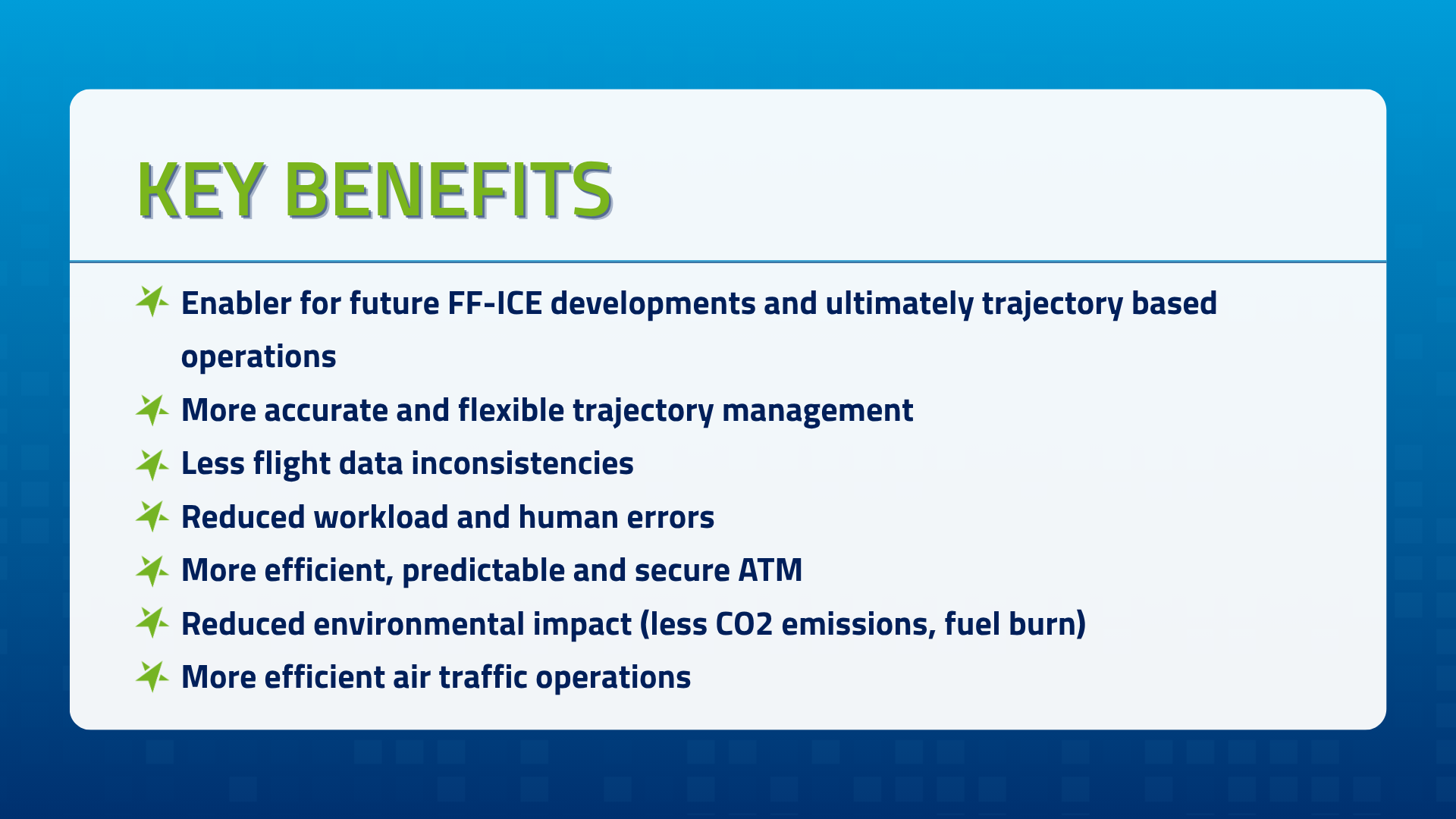
As the first ANSP to implement FF-ICE, ROMATSA supports data-driven decision making across the network. And although it has only just implemented the FF-ICE flight plans format, ROMATSA is already observing key operational gains. These encompass precise and adaptable trajectory management, fewer flight data discrepancies and human errors abd streamlined processes through pre-validated trajectories.
According to ROMATSA, FF-ICE enhances flight plan adherence, enables a more accurate and flexible trajectory management, less flight data inconsistencies, reduced workload and human errors, and improved decision-making – ultimately contributing to a more efficient, predictable, resilient and secure ATM ecosystem. FF-ICE further advances trajectory predictability, refines demand-capacity balance, and boosts overall flight efficiency.
In April 2026, Air Navigation Service Provider of the Czech Republic, ANS CR, successfully completed the implementation of the FF‑ICE concept into its flight data processing systems. Air Navigation Services of the Czech Republic