A trusted framework for information exchange
System-wide information management (SWIM) public key infrastructure (PKI)

With increasing reliance on digital systems, robust cybersecurity measures need to be implemented to protect ATM infrastructure from cyber threats.
Exchanges in ATM have traditionally relied on ‘older’ technologies such as the Aeronautical Fixed Telecommunication Network (AFTN) and Aeronautical Message Handling System (AMHS). AFTN, introduced in the 1950s, is still used today. Its replacement, AMHS, was introduced in the early 2000s and is now widely used across Europe, though implementation continues in other regions worldwide.
Both systems operate on closed, dedicated aviation networks and use strict addressing rules and message formats. While AFTN lacks built-in encryption or authentication and instead relies solely on network isolation, AMHS has added authentication and message integrity features (although it still operates on isolated networks).
SWIM is a modern system developed by ICAO to share aviation information. Instead of sending fixed messages like older systems (AFTN and AMHS), it uses data services, similar to what other industries use today. It also supports newer technologies such as cloud systems.
Unlike the older systems, SWIM is not limited to closed networks. It can exchange information over the public internet or through special networks like NEW PENS in Europe.
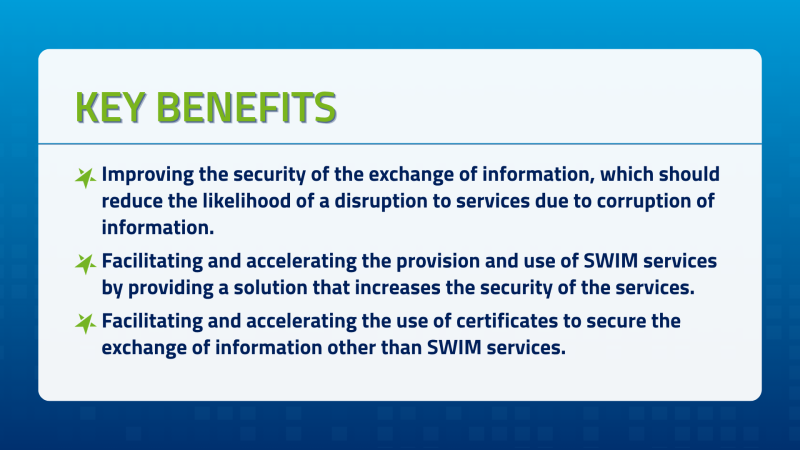
SWIM is secure by design. It implements transport layer security (TLS) encryption, digital certificates for mutual authentication, APIs and Public Key Infrastructure (PKI) to ensure secure, reliable and trustworthy information exchanges.
Because the CP1-mandated information exchanges require extensive digitalisation and the use of modern, IP–based communication, it is both essential and regulated that these exchanges take place over infrastructure capable of ensuring uninterrupted and untampered information exchanges and reducing the risk of cyberattacks.
THE INNOVATION
One of the most effective and widely adopted technologies for achieving secure information exchange is Public Key Infrastructure, PKI.
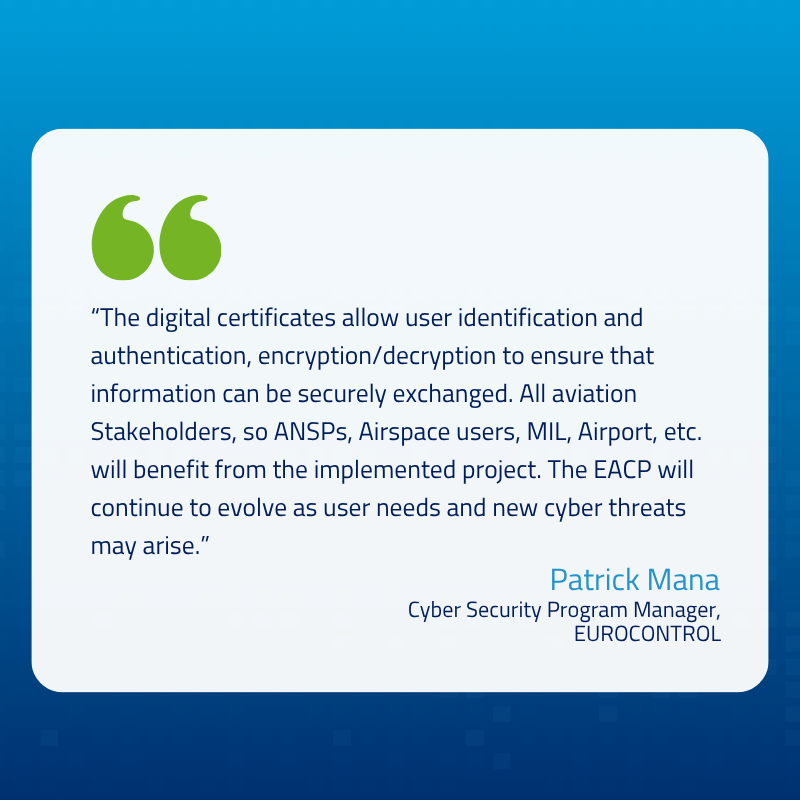
PKI provides cryptographic mechanisms and digital certificates that enable a secure and trusted exchange of information. It also offers a robust framework that protects the confidentiality and integrity of data, verifies the authenticity of information sources, and ensures that the identities of communicating parties can be reliably confirmed.
THE IMPLEMENTATION
The European Aviation Common Public Key Infrastructure (EACP) is a pan-European initiative designed to provide a trusted digital identity and secure information exchange framework for all aviation stakeholders. It forms part of the SWIM Common Components and is implemented through the SESAR Deployment Programme under Family 5.1.1.
The primary goal of this ATM family is to establish a common trust framework across various aviation stakeholders (ANSPs, airports, meteorological service providers, etc.) to ensure secure and authenticated information exchange via SWIM services.
Under the leadership of EUROCONTROL and together with the SESAR Deployment Manager (SDM), the common SWIM PKI was elaborated as a multistakeholder deployment project that involved 28 implementing partners across Europe. Together, they defined and developed the systems needed to operate a PKI and its associated trust framework, as well as produce and manage digital certificates.
Key deliverables include:
- Trust framework: a complete set of governance, membership criteria, service definitions, funding models, and operational rules required to operate the EACP.
- Interoperability tests: demonstrations and test results proving interoperability with PKIs in other regions (e.g., United States), ensuring a globally aligned trust environment.
- Call for tender materials: technical requirements, administrative documents, and award criteria needed to procure a commercial operator for the day-to-day running of the EACP.
- Operational contract: selection and contracting of the provider that will operate the infrastructure, manage certificates, enforce governance, and maintain security performance.
- Operational deployment: acceptance and entry into service of the EACP, delivering certificate issuance, validation services, signing services, and governance functions.
The deployment of the common SWIM PKI infrastructure strengthens cybersecurity resilience, reducing risks and costs associated with security breaches. In fact, it is estimated that it will have saved up to EUR 100 million by 2030 – just eight years after its implementation.