Enhancing operational capacity – in the air and on the ground
Airport operations plan/Network operations plan (AOP/NOP) integration

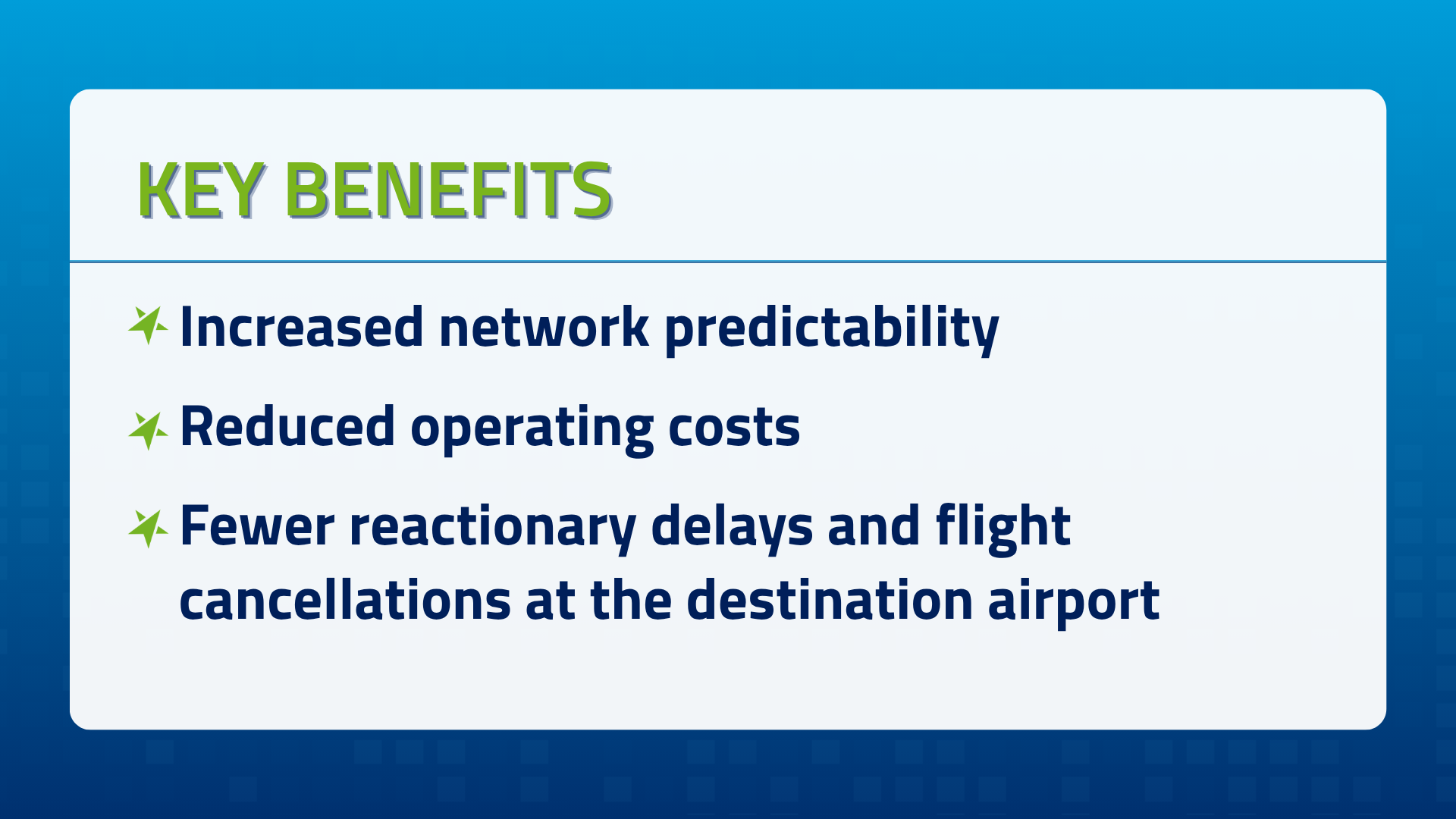
The integration of airport operation plans with the network operations plan moves aviation towards performance-driven, collaborative decision-making – giving airports, airlines, and air navigation service providers the benefits of improved predictability and efficiency.
Airport collaborative decision making (A-CDM) improves operational efficiency and punctuality by sharing real-time data among airport operators, airlines, ground handlers and ATC.
But as airports and airspace become busier and more complex, the data exchange offered by A-CDM isn’t always enough. What’s needed are solutions that extend the data horizon and enable a more proactive approach to airport and airspace management.
Those solutions are AOP and NOP.
Designed to proactively address the challenges and complexities of airport management, an airport operations plan (AOP) contains all the data, contextual information, scenarios and key performance indicators (KPIs) needed to enable collaborative decision-making. This one version of the truth is described as total airport management (TAM), which considers both landside and airside operations to improve the passenger journey, along with the efficiency of the airport operation.
The network operations plan (NOP), on the other hand, considers information in real time about the air traffic situation across Europe. Through the NOP, air navigation service providers (ANSPs), airlines, ground handlers, meteorological experts and airports can view the current situation and coordinate their activities accordingly.
When AOP and NOP are integrated together, it links airport-level activity with overall network management, providing an automatic, two-way exchange of arrival and departure information. By improving coordination, this integration enhances the ability of ATCs, airports and the Network Manager (NM) to predict disruptions and recover from them faster, as well as optimise resources and reduce delays.
THE INNOVATION
The SESAR Joint Undertaking (SESAR JU) has contributed significantly to enhancing AOP-NOP integration by developing tools, procedures and operational concepts that feed into the plan's evolution.
For example, its collaborative NOP solution (SESAR Solution 20) enables the NM, airports, airspace users and ATC to prepare and share information in real time. In doing so, it increases visibility of network performance and contributes to greater operational efficiency.
The SESAR JU also developed a solution to manage airport operations in a collaborative and proactive way using both the AOP (SESAR Solution 21) and the airport operations centre (APOC) https://www.sesarju.eu/sesar-solutions/airport-operations-plan-aop-and-its-seamless-integration-network-operations-plan. This solution, which targets high-traffic airports, provides the processes and tools needed to maintain airport performance in all operating conditions, build resiliency into the operation, improve passenger journeys, and share relevant information with the wider network.
THE IMPLEMENTATION
With these solutions in hand, the SESAR Deployment Manager (SDM) has implemented the AOP functionalities that allow for their integration into the NOP, enabling airports across Europe to integrate AOP-NOP into their operations (Project 2015 113 AF4).
Airports mandated for AOP-NOP integration according to Common Project One
| Adolfo-Suarez Madrid-Barajas | Düsseldorf International | Milan-Linate | Prague |
| Amsterdam Schiphol | Frankfurt International | Milan-Malpensa | Rome-Fiumicino |
| Athens Eleftherios Venizelos | Geneva Airport | Munich Franz Josef Strauß | Stockholm-Arlanda |
| Barcelona El Prat | Hamburg | Nice Cote d'Azur | Stuttgart |
| Berlin Brandenburg Airport | Helsinki Vantaa | Oslo Gardermoen | Vienna Schwechat |
| Brussels National | Lisbon | Palma De Mallorca Son Sant Joan | Warsaw Chopin |
| Copenhagen Kastrup | Lyon Saint-Exupéry | Paris-Charles De Gaulle | Zurich Kloten |
| Dublin | Malaga Costa Del Sol | Paris-Orly |
With AOP-NOP integration, these airports now benefit from having a rolling picture of the network and airport situation – complimented by shared operational planning and real time data that ATM can use to prepare and update their plans.
|
AOP-NOP in action Data from AOP to NOP for flight schedule alignment
Data from NOP to AOP for alerting service
|
According to SDM estimates, this integration has the potential to reduce en-route air traffic flow management delays by up to 5 million minutes by 2040. This means saving more than 5 million minutes of flight time, which corresponds to 200 million euros of monetised benefits.
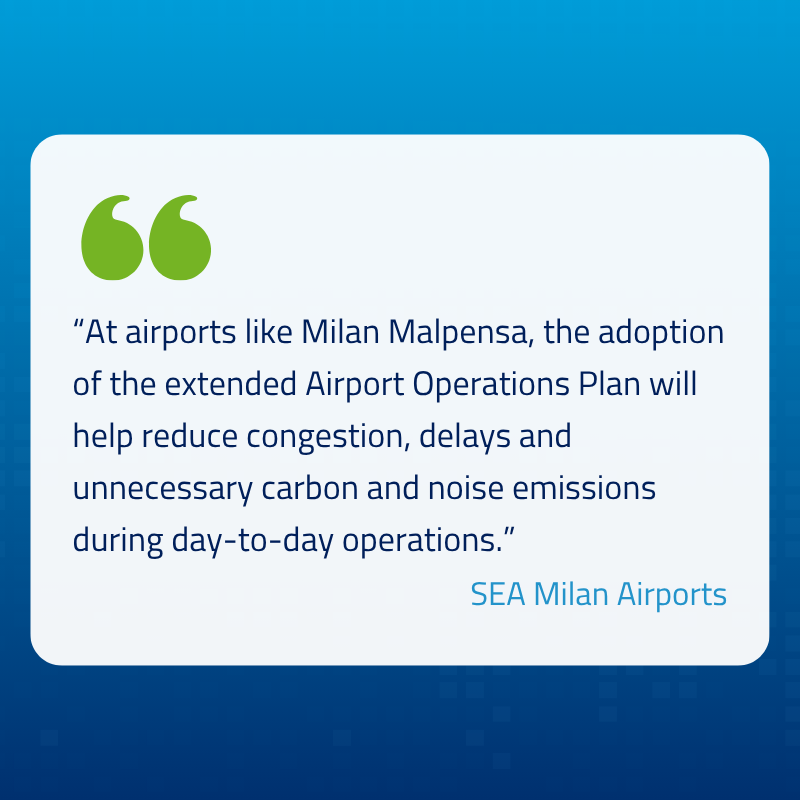
Working to extend and integrate the AOP with the European ATM network are two ongoing Common Project 1 (CP1) deployment projects: BEACON and EXOPAN. The EU-funded projects, which are being implemented with SDM’s support, have seen numerous airports and ANSPs agree to system-to-system data exchanges between the local AOP and airport operational stakeholders, as well as the sharing of relevant information with the NOP.
This exchange is being facilitated by the introduction of additional departure and general arrival planning information. In this way, airport operations can be managed more efficiently, resiliently and safely, both airside and landside.
|
EXOPAN[1] A collaborative effort involving several key European aviation stakeholders, including such airports as Amsterdam, Barcelona, Brussels (leader), Copenhagen, Dublin, Frankfurt, Madrid, Milan-Malpensa, Munich, Nice, Palma de Mallorca, Paris CDG and Orly, Rome, Stockholm and Vienna. The project also benefits from the contribution of the ANSPs at Berlin and Dusseldorf airports, as well as that of EUROCONTROL. These partners collaborate to implement the mature elements of the extended AOP across multiple airports, ensuring compliance with the data exchange requirements between the AOP and the NM. BEACON An initiative aimed at enhancing the efficiency and resilience of airport operations through improved data sharing and integration with the broader air traffic management network. Participants include Milan-Linate airport, with the main objectives being enhanced data sharing, operational efficiency and resilience, and performance monitoring services. A key element in this effort is the development of the extended airport operations plan (eAOP): a tool through which BEACON seeks to support both landside and airside operations. |