ASTONISH, a SESAR Exploratory Research project started on 1 September 2024 with 30-month duration, aims at developing innovative alternative surveillance solutions for Air Traffic Management/Air Navigation Services (ATM/ANS) and airport operations. It proposes to increase the future ATM/ANS system performance and safety, allowing for increased level of automation and connectivity.
Funded by European Union within the framework of Horizon Europe, the project focuses on three critical solutions covering all flight phases.
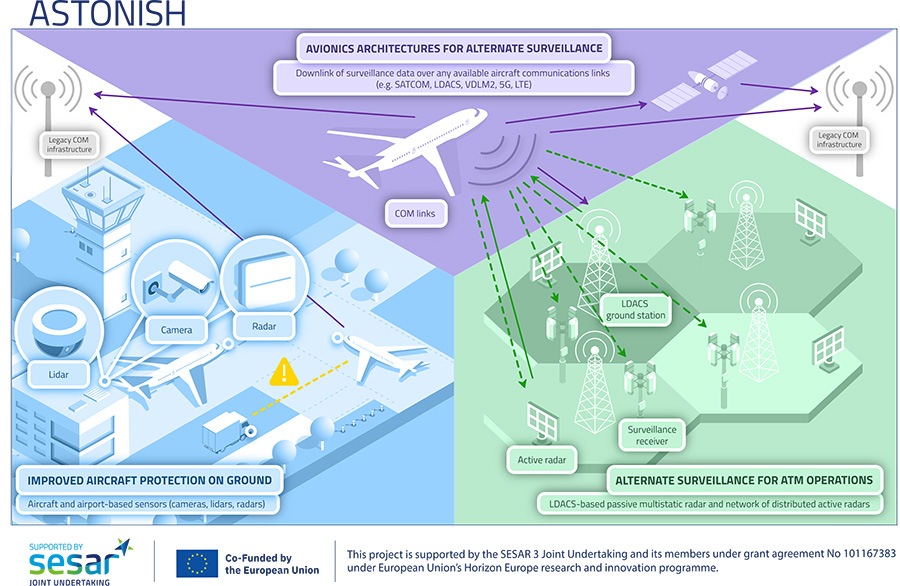
ALTERNATE SURVEILLANCE FOR ATM OPERATIONS [green area of the concept image]
This solution explores two ground-based non-cooperative surveillance technologies:
- Passive multistatic radar, by employing the transmissions of the future aeronautical digital communication infrastructure (LDACS) as signals of opportunity (solid lines), aims to detect aircraft through the reflections that these LDACS signals would produce when impinging on aircraft (dashed lines). This is intended to be used for terminal manoeuvring area (TMA) and En-route surveillance.
- Network of distributed low altitude active radars for TMA surveillance Each radar transmits a signal (solid line), receives the reflected signal (dashed line) and processes it locally.
These technologies enhance safety in sectors not covered by primary and secondary surveillance services, while also increasing capacity in areas where such surveillance is already in place, providing an additional layer of surveillance and a backup to traditional surveillance services.
AVIONICS ARCHITECTURES FOR ALTERNATE SURVEILLANCE [purple area of the concept image]
This solution aims at developing solutions to complement ADS-B by downlinking surveillance data over any available aircraft communication link (purple solid lines), such as SATCOM, LDACS, VDLM2, 5G and LTE during any phase of flight. It enhances existing surveillance infrastructure, which is essential for supporting the continued growth of air traffic while maintaining the highest safety standards. In addition, it helps mitigate security concerns in ADS-B by enabling the use of encrypted communication links.
IMPROVED AIRCRAFT PROTECTION ON GROUND [light blue area of the concept image]
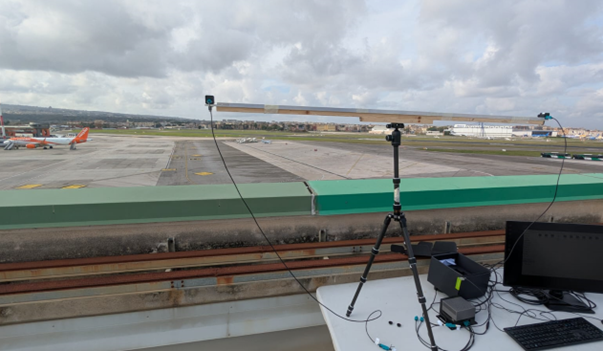
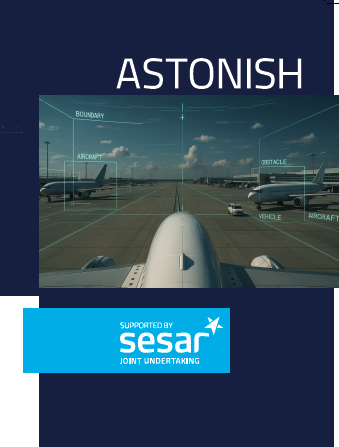
This solution is focused on the study of non-cooperative sensing technologies, deployable both on ground and onboard aircrafts. These include radar, lidars and cameras, which enhance surveillance systems capabilities during taxing and surface operations. These technologies are aimed to increase situational awareness of air traffic controllers and pilots and consequently improve the safety during ground operations, by detecting and localising obstacles in the surroundings of the aircraft that could potentially represent a danger also in poor visibility conditions.