Description
The BURDI project aimed to:
- Implement a U-space airspace concept capable of managing various, dense, and complex UAS operations in controlled, uncontrolled, and urban air mobility environments.
- Establish a reference for best practices, standardisation, harmonisation, and interoperability requirements, supporting the operational deployment of U-space airspaces across Europe.
- Ensure that deployed solutions are economically sustainable and socially acceptable for the benefit of the general public.
The project was implemented around the cities of Antwerp, Liège, and Brussels, where the proximity of international airports, an active maritime port, and the border with the Netherlands are considered key factors in the development of UAS operations in domains such as delivery, inspections, medical support, and security. UAS activities are an emerging economic domain that requires supporting infrastructure to integrate with the existing multimodal transport network. Against this backdrop, the project focused on the implementation of a reliable, sustainable, and safe solution for UAS integration within U-space airspace and UAM contexts. By establishing efficient u-space airspaces and providing associated services, the aim was to facilitate the safe and sustainable integration of multiple and complex UAS missions within the same area.
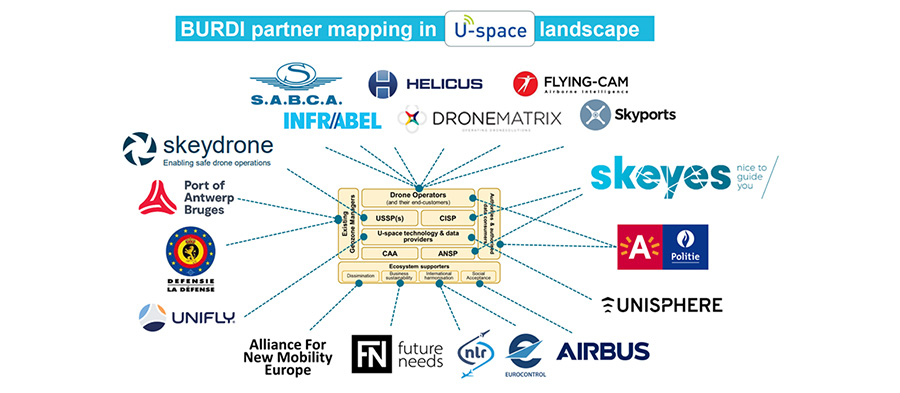
Demonstrations and operational procedures were carried out, with requirements being developed as part of the project. Key elements included the setup, certification, and implementation of u-space within Belgian airspace. Different roles were assigned to various stakeholders: skeyes served as the CISP, SkeyDrone as the USSP, and for the initial phase, PoAB acted as geozone manager for the early adopter area.
Use cases are being performed by different drone operators, starting in the early adopter area and gradually expanding to other u-space airspaces, providing services to a broad range of end users. The U-space implementation using the "burdi solution" will be assessed for sustainability and efficiency. With support from the Belgian Ministry of Defence and Antwerp Police, two additional use cases involved state operators. The project was structured into three incremental phases, with technical/system tests or real-time UAS flights conducted in the early stages to validate procedures and equipment before scaling up to a larger u-space solution.